Traceability in the EU Food Contact Materials Advantages of Hygienic Diaphragm Pumps Loss Reduction as a Real Competitive Advantage Automation and Occupational Safety Examples of Implementations Why Food Manufacturers Choose Diaphragm Pumps?
|
|
Article author: |

Transformation of the Food Industry
The food and beverage industry is currently undergoing a dynamic transformation. Rising quality requirements, new regulations, and the need to optimise costs mean that process installation design now requires a far more deliberate approach than it did just a few years ago.
The foundation of hygienic requirements in the European Union remains Regulation (EC) No 852/2004 on the hygiene of foodstuffs. It establishes the framework within which equipment and installations must be designed and maintained in a manner that supports food safety, including through solutions that facilitate cleaning and hygiene control during the process. The so-called “Hygiene Package” sets out a framework for the food industry that supports safe production and the manufacture of high-quality products.
Particular importance is now attached to such areas as:
full traceability of raw materials and products,
food safety,
transparency of production processes,
compliance with current and upcoming EU regulations.
New and key EU regulations require a higher standard of process equipment and apply to food-grade pumps, components, and documentation practices. This year, there has been a clear tightening of microbiological criteria for ready-to-eat food (RTE), which increases pressure on hygienic design and makes effective cleaning of equipment essential. From 1 July 2026, significant changes concerning Listeria monocytogenes in ready-to-eat foods will come into force under Regulation (EU) 2024/2895, which amends Regulation (EC) No 2073/2005. This substantially raises the requirements for hygienic installation design: minimising product retention points, ensuring ease of cleaning, and adopting designs that reduce the risk of contamination arising from the equipment itself, for example by eliminating dead legs and enabling easy, repeatable CIP cleaning.
This is precisely why food-safe pumps have become so important. They are responsible for transferring the medium, but their role goes much further. They affect process hygiene, downtime, ease of cleaning, occupational safety, and the final product quality. In practice, discussions about whether a production line is truly modern and well-designed very often begin with the pumps. Naturally, reliability must go hand in hand with robust construction and must also fit within the concept of traceability.
Traceability in the EU Means a Duty to Enable Easy Tracking Throughout the Entire Chain and Rapid Access to Data
Within the EU, traceability is a pillar of food safety. The European Commission emphasises that traceability makes it possible to quickly identify the source of a problem and withdraw products from the market. Put simply, it allows risk to be eliminated more quickly, moving from the general to the specific. The legal basis here is Regulation (EC) No 178/2002 (General Food Law), while Regulation (EU) 2017/625 organises and strengthens the system of official controls designed to ensure compliance with food law.
What does this mean for the selection of hygienic pumps and components? Food and beverage manufacturers typically define precise operating parameters when choosing equipment for their plants and focus primarily on performance. Today, however, that is no longer enough.
Engineers require highly detailed documentation, immediately available for audit purposes, together with consistent data on components, materials, and equipment configuration, so that compliance of both the process and the equipment with applicable requirements can be clearly demonstrated during inspection.
Food Contact Materials: Obligation to Demonstrate Compliance and Provide Declarations
Where equipment components come into contact with the product, the requirements relating to materials intended to come into contact with food are particularly important. These can be found in Regulation (EC) No 1935/2004. In practice, the manufacturer or importer is obliged to demonstrate compliance of the article with the applicable requirements, including by means of testing, and to issue a declaration of compliance.
At the same time, the principles of Good Manufacturing Practice (GMP) apply to how such materials are manufactured and controlled. This means that the production process must be organised, repeatable, and subject to continuous quality control. Every stage, from the selection of raw materials to the finished product, should be documented, and the material must be fully traceable.
Selecting food industry pumps and accessories “for years to come” now means choosing solutions that not only feature hygienic design, but also come with a complete set of documents confirming the materials used and the origin of the components.
A Global Shift That Extends Beyond Europe
A very similar direction of change can also be seen outside Europe. A good example is the United States and the requirements introduced under the Food Traceability Final Rule (FSMA Section 204). These provisions expand obligations related to traceability for selected categories of food and, in practice, mean one thing: the manufacturer must be able to quickly demonstrate what entered the process, where it came from, and how it moved through it. In many cases, the data must be available almost immediately, even within 24 hours of a request from the supervisory authority.
Hygiene as the Foundation of Installation Design
Modern installations must be designed in a way that eliminates the risk of product contamination. This means, above all:
 elimination of so-called dead legs,
use of high-quality stainless steel — in the case of Tapflo diaphragm pumps, AISI 316L stainless steel is most commonly used, characterised by high corrosion resistance and excellent hygienic properties, allowing safe contact with food and pharmaceutical media,
the possibility of fast and effective cleaning (CIP/SIP) — that is, cleaning the installation without disassembly (CIP – Cleaning in Place) and steam sterilisation in a closed system (SIP – Sterilisation in Place), which significantly reduces downtime and improves process repeatability,
minimisation of product retention within the installation.
Advantages of Using Hygienic Diaphragm Pumps in the Food Industry
Food-grade diaphragm pumps are perfectly suited to the above requirements. This results from their unique design:
they reduce areas where the medium may accumulate,
they facilitate easy cleaning,
they support the maintenance of high hygienic standards required by recognised standards and regulations, including EHEDG guidelines and FDA-compliant materials.
When designing an installation, it is important to determine how quickly the sanitary pumps can be dismantled and how complex their servicing is. This helps minimise the risk of prolonged downtime.
It is also worth verifying whether the pump manufacturer actually holds a valid EHEDG certificate (European Hygienic Engineering & Design Group). Why is this important? Because some manufacturers merely declare compliance with EHEDG guidelines but do not have formal documentary confirmation of this fact. And although EHEDG is not, in theory, a legal “must-have” imposed by EU law, in practice it has become a standard of hygienic design and a genuine advantage during hygienic audits. The EHEDG organisation itself publishes an extensive body of hygienic design guidelines, including those relating to process systems and CIP/SIP.
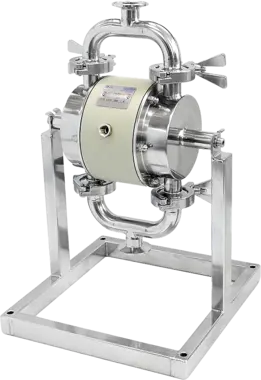
| Sanitary diaphragm pump | Aseptic diaphragm pump EHEDG certified |
 |

|
Perfect Product Transfer and Preservation of Product Quality
Diaphragm pumps:
do not cause product degradation,
provide low-shear transfer,
make it possible to handle both low-viscosity and highly viscous liquids, for example honey or oil.
As a result, the quality of the final product can be preserved without compromise.
In many food processes, preserving the structure of the conveyed medium is of key importance. This applies, among others, to:
dairy products, such as yoghurts and cream,
sauces and concentrates, such as tomato sauce,
products containing solid particles, such as chocolate with nuts.
Loss Reduction as a Real Competitive Advantage
At a time of rising raw material costs, every product loss has a direct impact on a company’s financial performance.
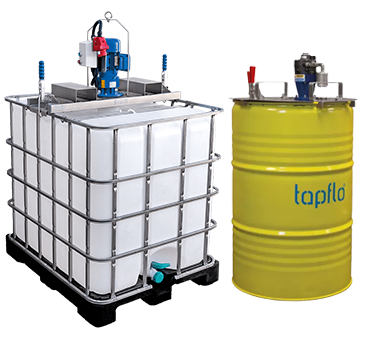
For this reason, solutions enabling maximum product recovery are gaining increasing importance. One example is the mobile skid known as HVS Quattro, which helps empty food drums quickly and efficiently. Its main advantages are:
it enables a 200-litre drum to be emptied in less than 2 minutes,
it allows recovery of up to 99% of the product,
it ensures a repeatable and organised working process,
it significantly reduces losses and production costs.
In large-scale installations, this translates into measurable savings and helps companies operate more efficiently and responsibly.
Need support choosing a food-grade pump? Contact our team
Automation and Occupational Safety
Modern production plants are increasingly investing in automation, because it is difficult today to maintain stable production based solely on manual operations and operator experience.
It is also highly significant from a hygiene perspective. The less direct contact the operator has with the product, the easier it is to keep the process under control and meet quality requirements.
In practice, automation is not limited to pump control alone. More often, it encompasses entire process subsystems in which precise management of medium flow and dosing plays a crucial role.
Automation delivers very tangible results:
it reduces human error,
improves production repeatability,
makes it possible to use installation capacity more effectively,
reduces the risk of occupational accidents.
In this area, solutions provided by Tapflo Solutions play an important part, making it possible to build complete systems rather than single devices. In addition to the aseptic pumps themselves, these systems include, among others:
control panels, enabling easy management of installation operation,
real-time pump performance monitoring systems,
solutions for precise dosing, mixing and blending products which can be adapted to a specific technological process.
Applications – Examples of Implementations
The value of these solutions is best illustrated by specific production examples.
Pumps for edible oils
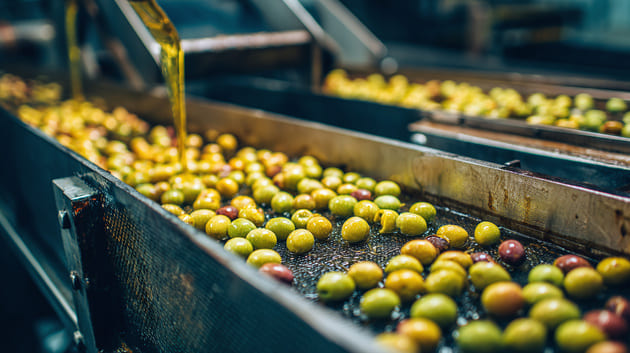
In installations for edible oils, process stability is of primary importance. The medium is relatively homogeneous, but sensitive to contamination and changes in operating conditions, and is often conveyed at elevated temperatures and in continuous mode. Under such conditions, food-grade diaphragm pumps perform well thanks to their durability and simple design. They enable safe product transfer while maintaining a high degree of installation tightness and reducing the risk of leaks, including during operation at elevated temperatures and continuous-duty conditions. For the operator, this means fewer unplanned shutdowns, greater predictability of installation performance.
Pumps for ethyl alcohol
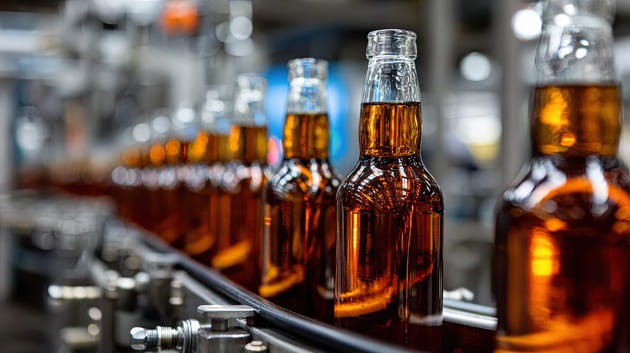
In the case of ethyl alcohol production, safety is of critical importance. ATEX zones require specific design solutions, and every leak represents a real ignition risk. The hygienic pump parts in contact with the medium and the surrounding environment should therefore be made of conductive or antistatic materials. In addition, the simple design of the diaphragm pump works to the installation’s advantage. System tightness, the absence of mechanical seals, and the ability to run dry and stall under pressure, simplify operation and reduce the risk of error.
Pumps for yoghurt and cream
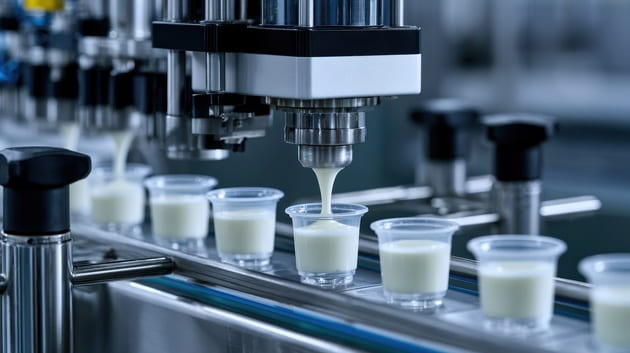
Very different challenges arise with products such as yoghurt or cream. Here, the product structure is crucial. Excessively aggressive pumping may impair its consistency and final properties. In practice, this means using solutions that do not generate excessive shear stresses. Diaphragm pumps make it possible to transfer such media in a stable and repeatable way, while limiting the impact on their structure.
Pumps for chocolate
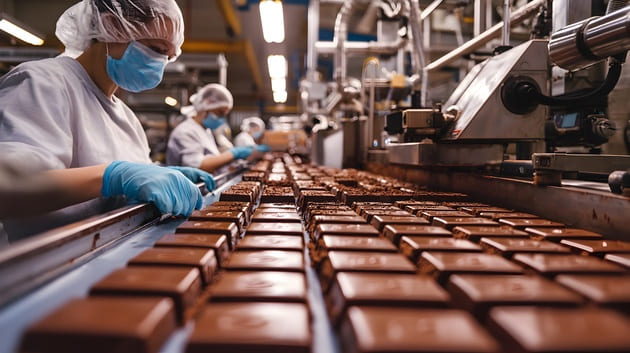
The most demanding example, however, remains chocolate. This is a medium with high viscosity and variable properties, dependent on temperature and composition, and its viscosity may reach as much as approx. 50,000 cP.
The primary challenge is to maintain the correct product temperature. If it is too low, viscosity rises and crystallisation may occur; if too high, product properties may be adversely affected. For this reason, heating jackets are used, including on the pump body itself, which stabilises flow and reduces chocolate build-up. The second important aspect is product structure. If the medium contains solid particles such as whole nuts, it is necessary to use appropriate valve designs. In diaphragm pumps, for example, flap valves are employed to allow the passage of larger particles without damaging them and without the risk of pump blockage. In chocolate applications, it is also important to reduce pressure fluctuations and stress within the medium. Properly selected aseptic diaphragm pumps provide stable, controlled transfer, which works well at high viscosity. Ease of cleaning is equally important. Chocolate tends to build up, which means the system must be adapted for effective CIP cleaning.
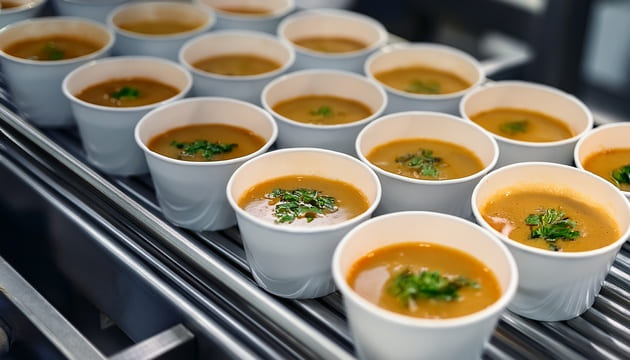
Pumps for soups
For cream soups, maintaining a stable flow and limiting shear stresses that could affect the product’s consistency is of key importance.
In contrast, for soups containing solid particles, such as pieces of vegetables or meat, the priority is to ensure smooth product transfer without the risk of damaging the ingredients or causing blockages within the system.
In such cases, a significant advantage lies in the flexible configuration of diaphragm pumps, including the use of interchangeable valve assemblies. Standard ball valves perform well with homogeneous media, whereas for products containing solids, flap valves provide a much more suitable solution, allowing larger particles to pass safely without damage or risk of clogging.
Why Food Manufacturers Choose Tapflo Diaphragm Pumps?
Tapflo pumps are designed for demanding industrial applications. Their key advantages include:
simple and robust construction (fewer parts = lower servicing costs),
easy and quick servicing,
absence of mechanical seals,
a high degree of installation tightness,
ability to run dry,
versatility of application,
the company’s many years of experience and global presence across numerous industries,
self priming
safe stalling under pressure
Hygienic diaphragm pumps represent a modern and reliable solution that supports manufacturers in building safe, efficient, and future-proof installations.
Searching for a pump for food industry? Check out our product portfolio